 Auf YouTube ansehen
Four Traps Keep Businesses Small. He's in One.
Auf YouTube ansehen
Four Traps Keep Businesses Small. He's in One.
Für dieses Video ist kein abspielbarer Embed freigegeben. Deshalb nur statische Vorschau und Link zum Original.
Volltranskript
Das Transkript ist das englische Original mit Timecodes. Die deutsche Zusammenfassung steht oben. Sprecher werden automatisch zugeordnet.
0:00My name is Walter from New Zealand. And um I have a question. So, I run a video business. >> Cool. >> And as part of that, I train people how to present as well. I've done a lot of TV hosting. And my question for you is if you were going to scale a video production {slash} photography business, what moves would you make to grow? Currently, we're only doing like 250k a year. >> Right. >> And I'd love to actually grow a real business. >> Sure.
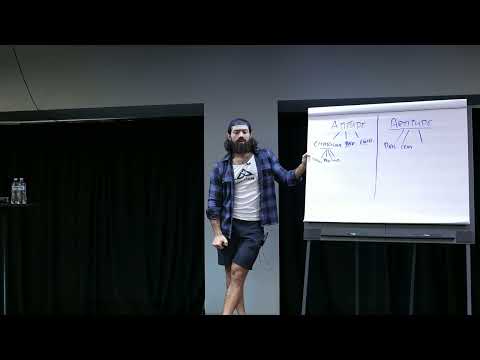
0:26>> Uh cuz it's just me and contractors. >> Yeah. >> And I'm trying to figure out what to do. I'm doing sales. I'm doing shoots, editing, you know, all sorts of stuff. >> of videos do you make? >> Uh like a range. Depends on what the client needs. So, it could be recruitment, could be promos, could be a content package. Whatever they need, I kind of meet with them, find out what they need, and then pitch it to them. >> Yeah. So, um this is great because there's there's one of four problems that most businesses get stuck on, and then they stay stuck until they figure it out. And you are in one of them. Uh which is uh you haven't figured out what to sell yet.
1:00And so, you can either be underpriced. This is some of you guys. You're at capacity, but you're not making any money. You're overcompensating, or you're wrongly compensating your team. The big fear there is that if I change my comp, I'll lose my team. Here, the big fear is if I change my price, I'll lose my customers. Uh the one that you have is uh you're you're selling the wrong avatar, or you have too many avatars. You need to pick an avatar. Right? And the fear there is if I if I narrow down who I'm serving, then I'm going to lose my business because I have to say no to money.
1:28Right? >> Yeah. >> But the thing is is that most of these kind of rock and hard place scenarios, uh you have to lean into the the hard part, which is there is one of these customers that you've served that you provided the most results for in terms of from a monetary perspective. Now, are you B2B or B2C? >> Uh B2B. >> Okay, great. Then yeah, everything's going to be about how much money you make. And so, then it's of the of the types of content that you make, which of them drives the most value? And so, if you got really good at making video sales letters, for example, there's a huge amount of money that companies will pay for that type of thing. And so right now, my honest advice is that you need to couple your ability to edit and shoot videos with an additional knowledge set.
2:07And so that means you need to understand the video stuff and social media. You need to understand the video stuff and ads. Or you need to send the video stuff and selling. And if you do that, then all of a sudden you're no longer selling videos, you're selling a result as a consequence of using a video. The video is just the vehicle, not the thing you sell. And then when you sell off of that result, your price can just basically go off go through the roof. >> Okay. >> And you'll find out that people want to buy that in reality, not a video package. >> Nice. >> It makes sense?
2:33>> Yeah. That's a good one. >> Yes, ma'am. >> Hello, how are you? >> Hello. >> Um we were talking about you earlier as I'm sure everyone in the room was. Um I love to think of like if Michael Phelps' parents never put him in the pool, we might not have an all-time Olympian. Do you remember the moment for you where your conviction, cuz you talked about that yesterday, like really started? So you went from gym bro trainer to a totally different direction in terms of building an incredible corporation. When was that for you?
3:02>> I don't think it was one moment. I think you just keep taking one step at a time. >> So you've loved compounding the entire time? >> I mean the it was I've always sold against the alternative. I was kind of like the you know what things are going to change? Well really like what things aren't going to change. And so for me the alternative was going back to something that I hated. And so it's just like well, this may be hard, but it's not as bad as what I was doing. And so I was like well then I'll just keep going. Honestly, that was it. >> Okay. >> Yeah, it's not a very sexy answer, but it's the truth.
3:30>> But it's real. Yeah, it builds everyone else's conviction in terms of keeping on the path. I mean, I think a lot of people can probably relate to the fact that coming here makes it feel like we know absolutely nothing about business. So unsexy is unsexy. >> Well, discrepancies are important um because those are fundamentally like areas of opportunity. And I think, um, the the whole imposter syndrome concept really comes in when you haven't done enough work.
3:59And so, like, I have I have I think I might be I might be sent more sensitive to imposter syndrome than most people. And so, because of that, I do enough work that I'm like, "No one could ever say this isn't legit." >> [laughter] >> And that's and that's kind of how I approach it. And so, when it's like, if you if you look at my my business history, I was a multiple state record uh holder in Maryland, and I just worked out really hard, and then people started approaching me being like, "Hey, can I give you money in exchange for advice?" And I was like, "Okay.
4:33You sure?" And they're like, "I mean, did you have a state record?" And I was like, "Okay, I guess I can help." And so, then they gave me money, and I was like, "Oh, that's so sweet. That's cool. I didn't know you could do that." And then I built a business around giving people advice for getting in shape. And then, once I started doing that really well, all the people who had businesses around helping people get in shape were like, "Dude, you have six gyms and you're 26. Like, how did you do that?" And I was like, "This is how I did it." And then, once I did that, and I built a business around Yeah. uh licensing information that went really big and national, all the people who had bigger businesses were like, "Dude, how did you scale that by the time you were 29 or 30?" I was like, "I don't know, this is what I did." And so, fundamentally, every step, I've just been I just share what's worked. And so, it's not making promises about what will happen for somebody else, but more standing on the fact of what has happened for me.
5:17And then, take it or leave it. And I think that way, you never have to say, "This is what you should do." I mean, I don't know if you guys have noticed this, but like, I'm very careful with my language and saying like, "This is what I have done. This is how I did it, not how you should do it." I try to remove should entirely from my vocabulary. I just say, "You can do whatever you want. This is what worked for me." If you're a business owner, and you are not growing as fast as you'd like, I'd like to give you a free gift. So, my team and I put together the $100 million scaling road map, which is basically 200 hours of us looking over all the portfolio companies we've had and what stages of growth they went through and more importantly where they got stuck and how they got past it. And so we broke it into these 10 stages and we made this little kind of quiz thing where if you put in your business information it'll tell you where you're at and the most important part for you what to do for each of functions of the business across product, marketing, sales, customer success, recruiting, IT, human resources and finance. And so no matter what you're struggling with someone else has already struggled with it and solved it. And so I'd like to give you this thing absolutely free. You can go to acquisition.com/roadmap, plug in your business information and if you want us to actually help you deconstruct the business and you're trying to scale we'd love to help you out. On the thank you page you can book a call with my team and we will look at the business, see if we can help and if we can we'll invite you out to Vegas and we'll do this in person live.